
Towards a post-cynical era
« L‘art pour l’art, sans but, car tout but dénature l’art. Mais l’art atteint au but qu’il n’a pas. » – Benjamin Constant
“Art for art’s sake, without purpose, for every purpose distorts art. But art achieves the purpose it does not have.”
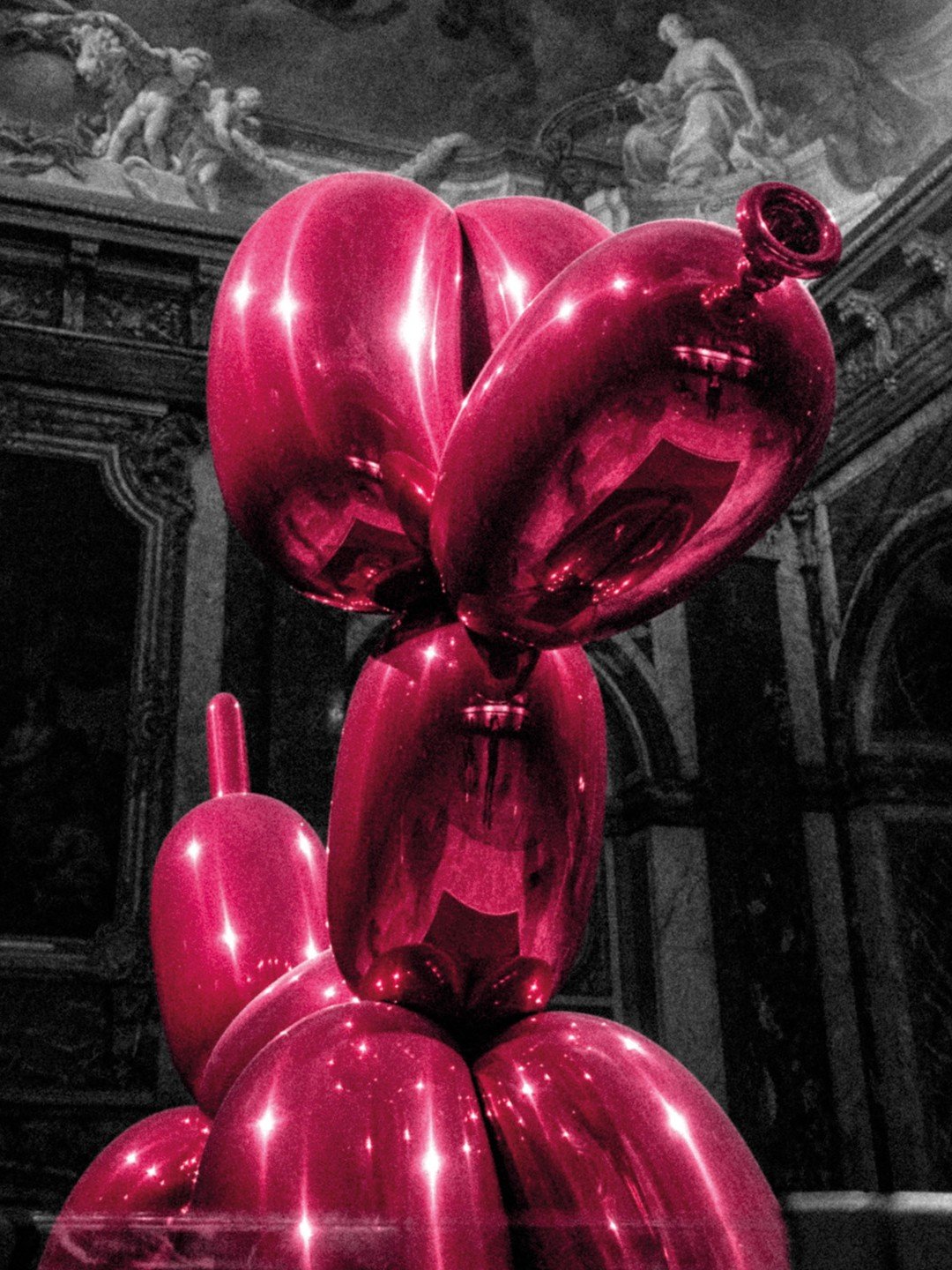
The contemporary art and culture scene could be predominantly described as “cynical”. From the best-selling work of Jeff Koons, whose work makes up two of the five most expensive artworks by a living artist, to the endless installments of carbon copy megafranchise superhero films and their deconstructive counterparts that seek to endlessly subvert those very same heroes’ journeys, we cannot help but feel that things are not ideal. But what can we do?
We are advocating for a “post-cynical” shift. Post of course implies moving beyond the current thing, but we have to take where we are now as a starting point. And that means we need to understand the reasons that have led us to what we could call the “Cynical Age”. Of course, we are not claiming that all art today is cynical. Not at all. Every age produces its great art. But the designation “cynical” should not make a distinction between good and bad art; it seeks to describe a dynamic which – we would argue – implicates everyone, to a certain degree.
In what follows, we will describe the features of a cynical stance in artistic culture; unearth some of the historical reasons why we got here and tease out what are legitimate concerns and what are not. We will then turn to some of the paradoxes and self-contradictions of the cynical paradigm and conclude with an outline of what might characterise “post-cynical art”. However, the post-cynical era we advocate for will not be entirely new. It must be new, insofar as it cannot be either a romantic return to an older age or a continuation of the current paradigm. Nevertheless, it must retrieve wisdom from the past and seriously engage the experiences and insights that led to the cynical stance in the first place.
WHAT IS “CYNICAL” ART?
We call much of current artistic production “cynical” because it works with criteria that do not intrinsically emerge from artistic work itself but from external sources (ideological, economic, political). Today, art emerges not merely from artistic processes or expression per se but from the need to “belong” to an in-group. Art, then, is in danger of not emerging from artistic imagination but rather being produced for social recognition or monetary gain. In doing so, art propagates the ideal of an independent “art sphere”; its production is very much influenced by these dynamics. That, fundamentally, is what makes it cynical.
We want to suggest three characteristics to describe cynical art: (1) it is produced in isolation, (2) its meaning is not public but rather esoteric and (3) it is, for the most part, ironic. Though all these are historically motivated by genuine reasons, in the final analysis, they are not intrinsic to artistic work and even endanger it. Let’s take a look at all three in turn.
(1) Art has become isolationist to the degree that it consciously uncouples itself from all other spheres of common life and retreats into a sphere of its own (art pour l’art). The imagined artist-genius works alone in the studio – culture-making in the atelier is understood as an exalted mode of being; the atelier becomes a counter-world, unspoiled by the anxieties, needs and values of the world “out there”. The “masses” are invited, from time to time, to experience some of this artistic world in a gallery show. They are the new prophets of the age who have uncovered, within themselves, and in their isolation, an elevated insight into reality itself. The “white cube,” a neutral, empty space devoted for nothing but the product of this genius, becomes the appropriate venue for such works.
The logical endpoint of such a conception is solipsism: A form of self-sufficiency that leads to hermetic self-referentiality. 1 Some movements have tried to work against that, to situate art in the everyday, in public spaces, to blend the borders between the artistic, the commonplace and the political. Such initiatives however tend to fall outside the category of “art” in a more traditional sense and are probably better labeled “activism”.
(2) The cynical dynamics encourage art to be esoteric – that is, accessible only to a small number of people with stakes or special interests in the art sphere. Thus, cynical art is created, commented on, and commercialized by a select circle of elites, who are already inducted into the mysteries of art criticism. Hermetically sealed off from the wider public, the cynical art scene is proud not to follow transparent rules that a wider audience could appreciate. Instead, it conjures up its own hidden rules, standards and criteria. One must be initiated into the signs and symbols of this community, and into the web of self-referential codes, in order to see properly. Art, in this way, becomes the business and rite of a small number of expert critics with specialized knowledge about salient ideas, practices and cultural codes.
We are not the first to bemoan this. There are longstanding (leftist) traditions of criticizing the art world for failing to take a committed stance on current issues. But even in these traditions, the basic idea of artistic autonomy remains operative.
(3) Cynical art, finally, needs to be ironic. It seems like a thing beneath the dignity of an artist to be genuinely taken in by some concern or issue. Signalling loyalty with a cause or the will to “say something important” risks embarrassment. It is much safer to be clever, cocky and to remain in the safety of parody and ridicule. A “true artist” then keeps even their own artwork at arm’s length, maintaining critical distance from any artistic form, content, or object.
David Foster Wallace has summarized the cynical stance well: “Postmodern irony and cynicism’s become an end in itself, a measure of hip sophistication and literary savvy. Few artists dare to try to talk about ways of working toward redeeming what’s wrong, because they’ll look sentimental and naive to all the weary ironists. Irony’s gone from liberating to enslaving. There’s some great essay somewhere that has a line about irony being the song of the prisoner who’s come to love his cage.”9
David Foster Wallace has summarized the cynical stance well: “Postmodern irony and cynicism’s become an end in itself, a measure of hip sophistication and literary savvy. Few artists dare to try to talk about ways of working toward redeeming what’s wrong, because they’ll look sentimental and naive to all the weary ironists. Irony’s gone from liberating to enslaving. There’s some great essay somewhere that has a line about irony being the song of the prisoner who’s come to love his cage.” 2 Wallace, David Foster, “Interview with Larry McCaffery”, in: The Review of Contemporary Fiction (1993).
HOW DID WE GET HERE?
Even though we want to move beyond them, these symptoms have historical contexts and mark significant developments of cultural production. Art has been freed from problematic entanglements with various projects in successive revolutions.
Historically, artistic forms have indeed been instrumentalized for ends, ranging from relatively harmless “bourgeois” ideals to totalitarian regimes – as was the case with socialist realism under Stalin and Nazi Art in the Third Reich. Dictators seem to know that art is a serious and powerful force.
The horrors of the 20th century have made the beautiful forms of European art appear suspect. If beautiful forms can be abused to legitimize hideous deformity, does that not compel us to refrain from the ideal of beauty altogether? Is it not better to face down “reality” head-on, unvarnished and ugly?
At the same time, the legitimacy and purpose of art have come under pressure from another angle: technological innovation. Do we still need paintings if we have photography and film with increasingly realistic quality? These questions are exacerbated today by debates around so-called “generative artificial intelligence.” As a consequence, fine art detached itself from the figurative depiction of the sensible world, charting new and increasingly abstract territory. But the novel terrain proved limited in scope, an esoteric sphere governed by its own logic and laws – a safe space protected from interventions from the outside world, but also irrelevant to it.
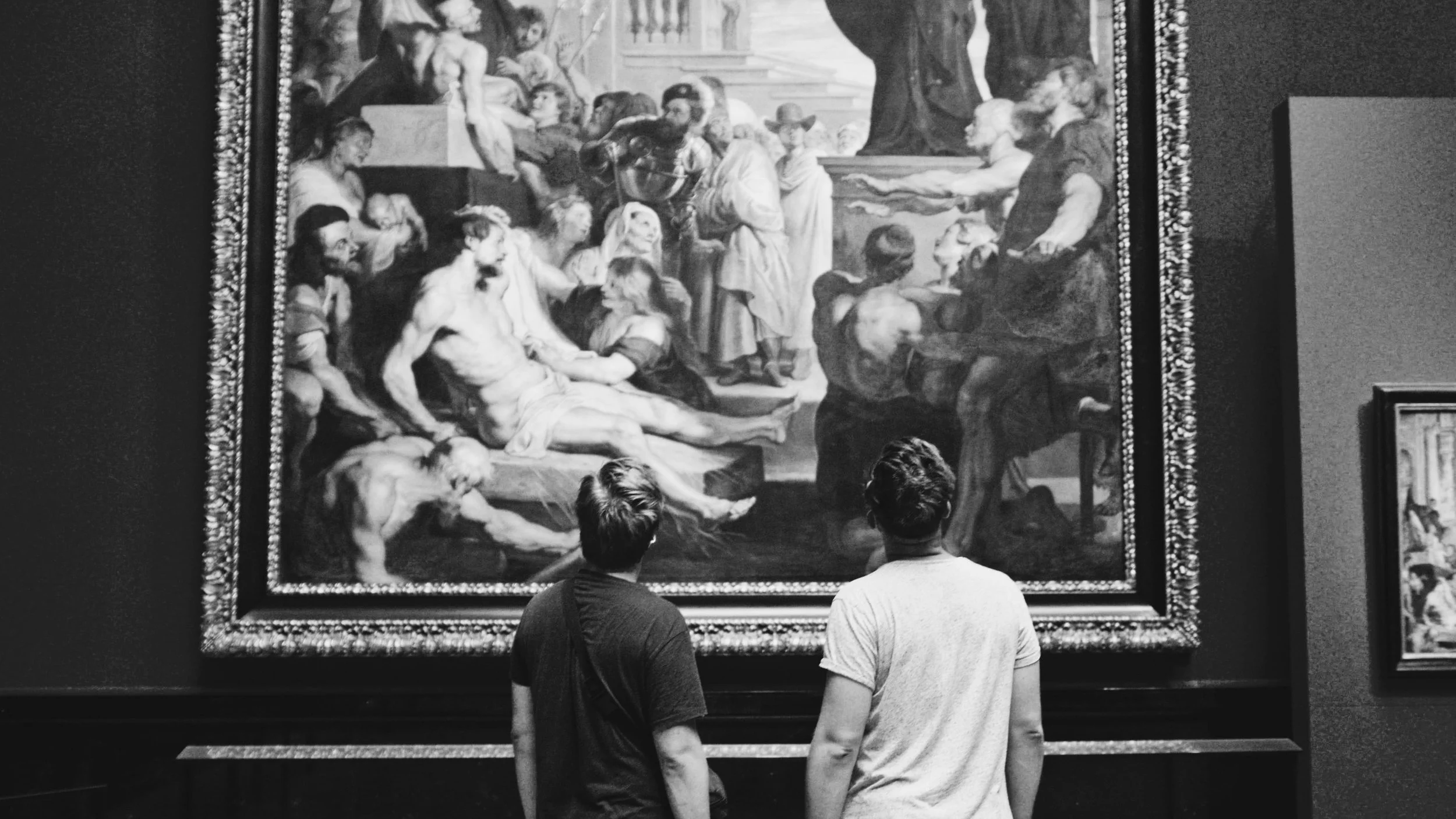
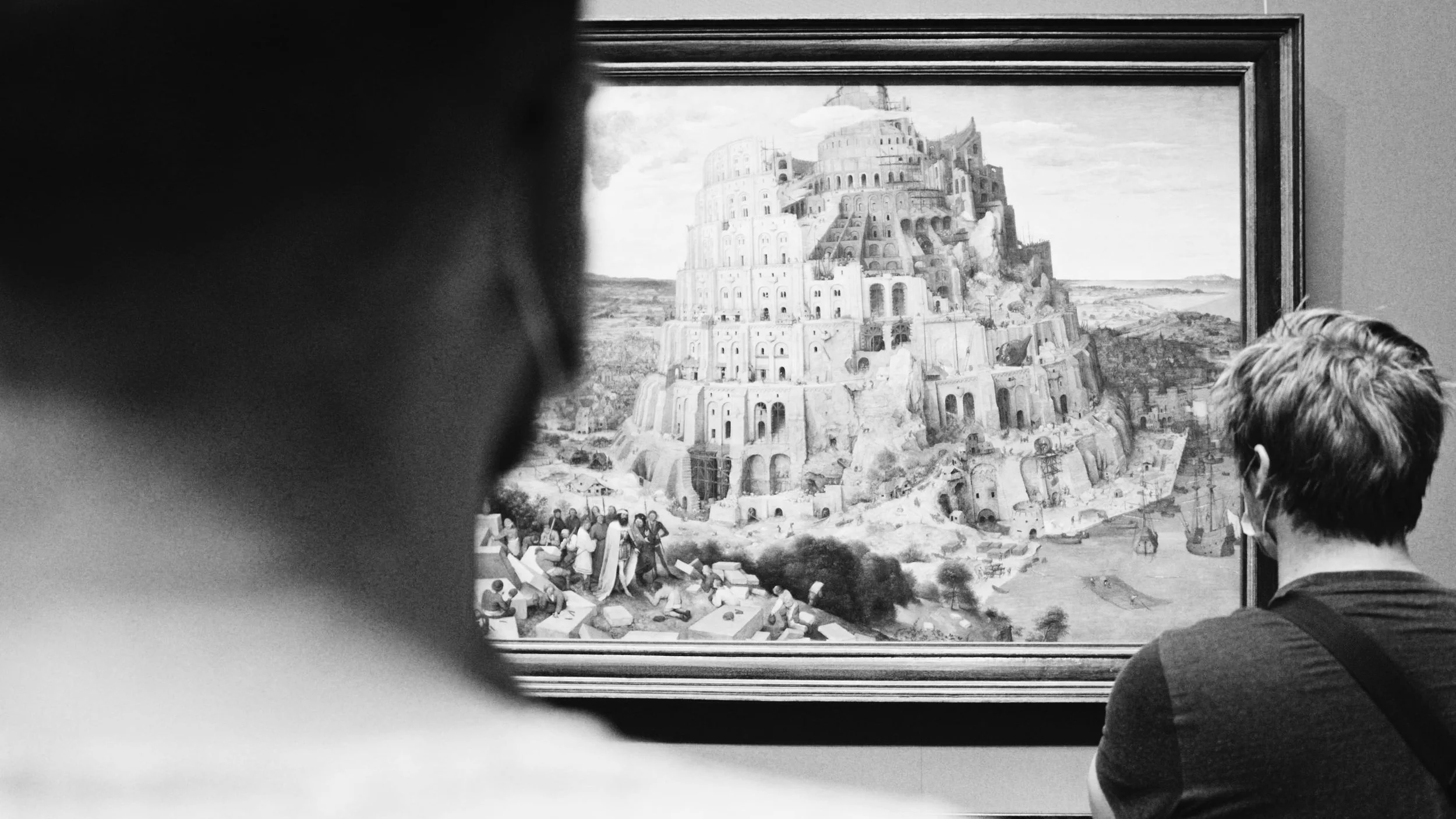
On Set: Kunsthistorisches Museum Wien
Furthermore, the origins of cynical art are rooted in the fundamental shifts we associate with the Enlightenment project of “modernity”, understood as the explosion of possibilities resulting from “unchaining” reason from any moral, metaphysical, or religious embedding. 3 Of course, this de facto only results in a new (or revived set of old) moral, metaphysical and religious embedding – many Enlightenment thinkers merely replaced a version of Deism with a version of Epicureanism.
Paradigmatic for this development is Duchamp’s Fountain (1917) – an unaltered urinal, declared and exhibited as “art”. Duchamp’s readymade marks both the “unchaining” of art from any criteria, an explosion of possibilities for the arts, but also the end of art – if everything is art, then nothing is art. An art scene without criteria of discernment here can only continue its business cynically.
We want to take this one step further, however and understand all three dynamics of cynical art – isolationism, esotericism, irony – as strategies of self-protection, or preemptive self-criticism. If an artist does not adhere to publicly accessible rules, ideals, or conventions, their work cannot be assessed by any standard of form. Calling such an artwork “good” or “bad” or, for that matter, “beautiful” is either a category mistake or a purely subjective statement of taste. Thus, cynical art contributes to the demise of traditional forms of “craftsmanship”. One cannot judge quality without criteria and one cannot make up criteria for the incomprehensible. Furthermore, if someone is already ironic about their own artwork, its form, content and object, then it makes no sense to criticize them for it. The only critique left to the public is to call an artwork “inaccessible,” “obscure,” or “out of touch with the real world” – but in certain circles, such charges are worn as a badge of honor.
THE IRONY OF CYNICISM
A closer look reveals inherent inconsistencies in the cynical paradigm of detachment.
Art cannot really isolate itself and avoid engaging the world beyond its borders. Factually, it does engage society; it moralizes, condemns, praises, elevates, reprimands. Even though art does not wish to be criticized, it criticizes. It denounces instrumentalization, but cannot evade being instrumental in its own way, consistent with its own agenda.
It rightly criticizes abusive instrumentalizations of beauty and dares to explore ugliness. But instrumentalization (of beauty) towards bad ends is confused here with instrumentalization tout court. Nevertheless the old principle still holds: “abuse does not nullify (adequate) use” (abusus non tollit usum). By rejecting all notions of aesthetic principle on the basis that it has been politically instrumentalized in the past, cynical art became crude. It banished not only the classical canons of beauty but also crafts and the myriad ways in which beautiful art can serve truth, goodness and justice. Now, we are presented with a new set of ideals. And although they are held up with irony, they are held up nevertheless.
If every definition excludes (omnis definitio est negatio), every exclusion defines. Thus, paradoxically, by discarding beauty as an aesthetic principle, ugliness was established as its substitute. In a sense, the endpoint of the struggle for artistic freedom was always ugliness. Why? Because the strange allure of beauty works as a verdict upon every artwork. Complete autonomy of art means that art will no longer bow even to that. So, the attempt to create something beautiful has become doubly suspicious: for its problematic associations, as discussed above, but also for its submission to this seemingly objective (albeit elusive) standard. The result, however, is not freedom from standards, but ugliness (sometimes disguised as “functionality”) as a standard enforced against every attempt to reintroduce beauty into the picture.
Thus, cynical art cannot escape purpose; it is thoroughly shaped by a telos, an end, a corresponding narrative and ethos. It must reckon with this fact, or it will delude itself. We cannot avoid normativity; we must learn to navigate differences, to cultivate moral and political discernment of worthwhile ends and to reconceive the imaginative role art plays on this human stage. It is cynicism that allows a cynical art scene to uphold lofty ideals of detachment while de facto sullying its hands.
WHAT COULD A “POST-CYNICAL” ART LOOK LIKE?
Post-cynical art does not ignore the legitimate concerns of art theory and criticism. Art will always be in danger of being instrumentalized and beauty will always be in danger of being used to embellish and legitimize questionable ends.
In a plural and open society, however, the conversation about what makes these ends questionable – and others legitimate – must be held on an even plane and in broad daylight. Thus, post-cynical art must take up and deepen critical consciousness. To deepen means to break through mere negation and to wrestle with that which inevitably is affirmed in every stance – critical, naive, or other.
The three attributions “isolated”, “esoteric” and “ironic” could be counterweighed by their opposites. “Post-cynical” art should be: vulnerable, accessible and beautiful.
Rather than immunize itself against criticism, the art of a new era should embrace the dangers of public meaning production. Essentially, this is a democratic gesture. This new art aims to communicate with everyone. Its reference point and goal are congruent with those of the wider public and of spheres outside of the narrowly circumscribed world of the white cube. That mustn’t be linked with submission to this or that project, but through critical engagement with the themes and stories that shape all our lives – and a facing up of the reality that there is no neutral space absent from these dynamics. “Post-cynical” art will address its audience not in its own private language (which is an illusion anyway), but in a shared space of attention and meaning. It will be produced in a climate of exchange with different spheres of society, so as not to have itself as its only subject (art for its own sake). It will not create esoteric rules, but adhere to shared ones. Finally, it will dare to earnestly, and sincerely – that is, unironically, but with critical self-awareness – attempt to get at the central aim of art through the ages: beauty.
Beauty has been contested for centuries. It is a complicated, multifaceted discussion and there is no end in sight. Nevertheless, it was a guiding principle for “pre-cynical” art and “post-cynical” art will not shy away from this central vocation and power of artistic production. That, again, is no return to a naive understanding, but a breaking through to a mature stance that faces up to beauty as one of the most fundamental characteristics of reality – one that a truly realist stance cannot ignore, much less deny.
CONCLUSION
Pushing back against the malaises of cynicism, post-cynical art must be accessible and comprehensible to the public. It must participate in a public conversation about truth, goodness, justice and beauty. It must be characterized by the courage to negotiate worthwhile purposes, to allow critique and to submit to judgment. Post-cynical art will be contentious – and that is how it should be.
However, post-cynical art must push through to the other side and develop critically self-aware art that aspires to a sober beauty – that is, beauty that faces, not evades, the shadows of history. Michelangelo’s Pietà illustrates how even this most horrific moment of a dead child in a mother’s arms can be rendered beautifully, not in a way that glazes over the pain and suffering, but makes it bear upon the viewer ever more forcefully. Instead, by being beautiful, it also gestures, timidly and hopefully, beyond the suffering to a possible recollection, restitution, resurrection.
Finally, post-cynical art must cease to be cynical and also cease to be “post”. Its future must not be determined negatively, but positively, through the blossoming of new forms and content in productive dialogue with both tradition and the radically new.