
Interview with Jan-Marc Furer
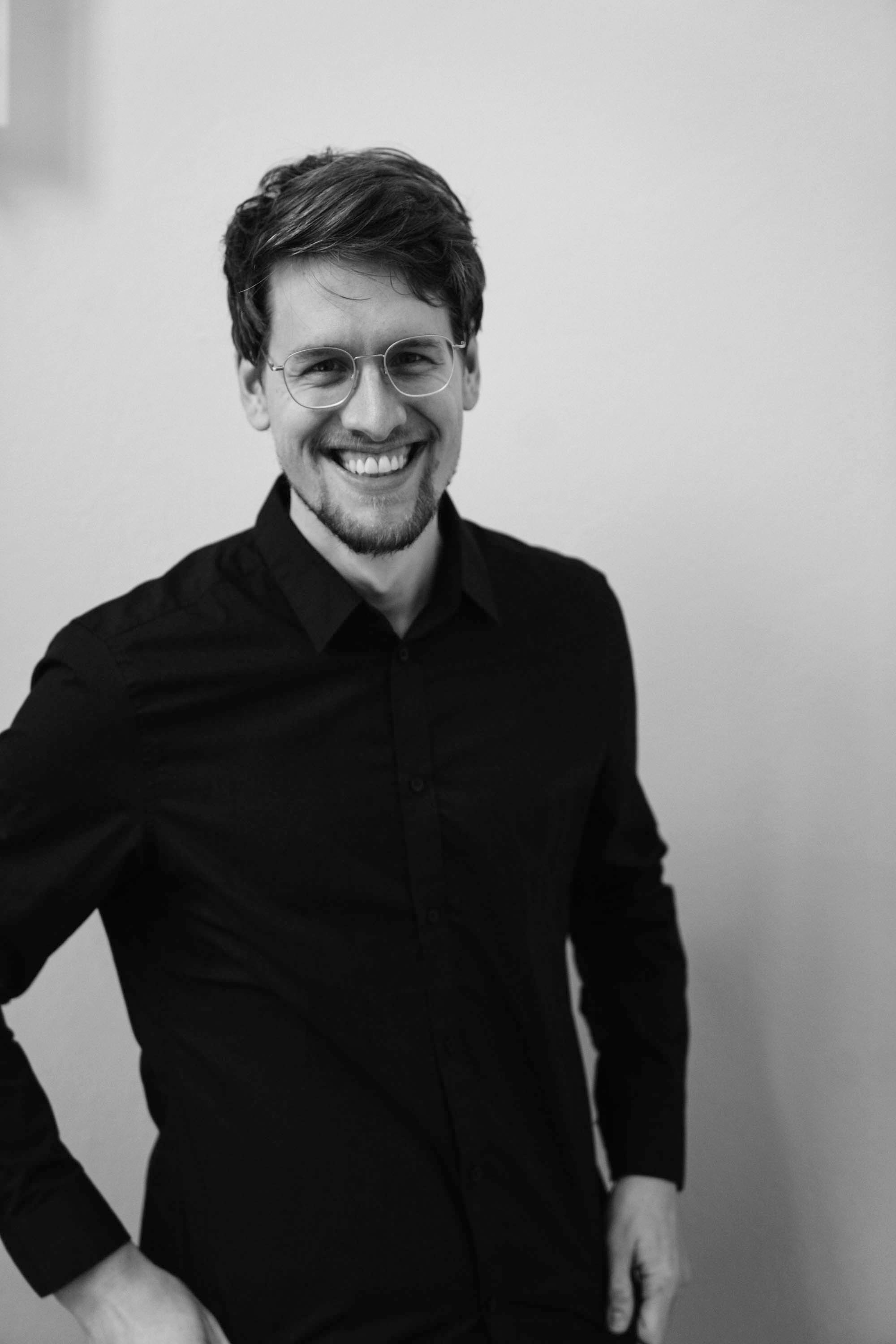
Jan-Marc Furer is a trained film technician, video journalist and screenwriter who works as a documentary filmmaker at HKB and Schwarzfalter GmbH.
As a team of artists, scientists, and creative minds, Schwarzfalter GmbH combines film art with sound research to develop and produce feature films, entertaining educational clips, and science communication projects. Thanks to their sophisticated and innovative ideas, the Renaissance Society has funded several film projects created in collaboration with Schwarzfalter GmbH and Jan-Marc. In this interview, Jan-Marc talks to us about his passion.
You’re a film professional and spend your days immersed in moving images. Is a night at the cinema with your wife still a pleasure for you, or do you ever feel visually saturated?
On the contrary—I love watching films in my free time. Occasionally I try to maintain a professional distance and pay attention to technical details. But I almost always fail, because I get completely drawn into the story and end up simply enjoying the film.
What shaped you as a child or teenager in a way that sparked your desire to pursue a career in film and television?
As a young boy, I was fascinated by epic films like The Lord of the Rings and action movies starring Jackie Chan. Over time, I became increasingly curious about how such films were actually made.
A formative phase for me was when I completed the “Strategic Life Training” program in our church community. One of the key texts was Francis Schaeffer’s How Should We Then Live?, which explores the formative power of film. That was the first time I realized just how profoundly important films are for society.
At that point, I was still considering becoming a police officer. But then I sensed something like a calling from God into the world of moving images.
As a filmmaker, you are essentially a storyteller. What defines your approach to storytelling?
When selecting topics for our films, we often seek out stories that deserve greater attention today. Sometimes the process begins quite casually—someone mentions the life of a fascinating person or a compelling historical event. And then something begins to grow within us. We explore the idea of turning it into a film. If we sense the idea deepening and enthusiasm building, we decide to create a film in order to give that person or theme a new platform.
Our aim is always to present complex issues as clearly and accessibly as possible. We deliberately take on challenging material and wrestle with how to translate it effectively into film.
Many of Schwarzfalter’s productions engage with Christian themes. As a director, are you primarily trying to teach—or to evangelize?
I believe the long history of Christianity offers an immense wealth of compelling stories that address themes highly relevant today. I take great joy in bringing these stories to life.
I don’t see myself as either a teacher or a missionary. My desire is simply to share the deep fascination I feel for a subject or a person. That said, perhaps there is something missionary about wanting to share the insights you’ve gained from a story—or your reflections on a powerful theme—with an audience. Especially when that desire is fueled by genuine enthusiasm.
How does your faith shape the visual style, aesthetics, or narrative voice of your films?
Our team members come from a wide range of Christian traditions. Artistically, that diversity is an extraordinary gift. It influences our work both consciously and unconsciously. We take great pleasure in developing an aesthetic shaped by the depth, complexity, and richness of Christian visual traditions. This is not something we deliberately plan; rather, it naturally finds its way into our cinematic language.
We also engage deeply with the theme of suffering. Yet our films consistently carry a note of reconciliation and hope. In that sense, we quite naturally draw on the power of resurrection—the new life that dwells within us.
Schwarzfalter works in a highly collaborative way. How do you cultivate respect within your team, and how do you handle tensions?
Open discussion is central to our work—and those discussions can be quite intense. I had to learn that it was precisely through these debates that we grew. They have not only improved the quality of our work but have also strengthened our friendships. Learning to navigate conflict together has deepened our mutual respect.
Between niche and mainstream audiences—how does Schwarzfalter position its projects, and what strategies do you pursue?
We are fortunate that many of our projects are commissioned works, where the client already defines the target audience.
Personally, I find it particularly challenging to create films with complex themes for a broad television audience—viewers ranging from those with little formal education to academics, and with worldviews spanning from devoutly religious to atheistic. Striking the right balance is demanding.
It becomes more straightforward when we are producing commissioned works according to a client’s specifications. At present, for example, we are working on a film marking the 500th anniversary of the Reformation, focusing on the figure of Niklaus Manuel. The project was commissioned by the Church of Bern and will premiere at a theological congress.
Praise and criticism are the echo of your work. How important are they to you?
We were fortunate to receive very positive reviews and awards at major film festivals for our film End of Humanity. That certainly brings joy and a sense of pride. What matters most to me, however, is the feeling that our message has truly been understood—especially when recognition comes from a secular jury.
We take criticism seriously and try to learn from it. Fortunately, we rarely receive harshly negative feedback. Most critical responses point to specific weaknesses within a film. We are well aware that no film is perfect, so such feedback does not surprise us. In fact, constructive criticism is almost always accompanied by generous and encouraging responses—and for that, I am deeply grateful.
Thank you for the conversation.